What is a Pro forma invoice
A pro forma invoice is an invoice issued as a preliminary bill of sale to the client before the work is done. It contains the list of deliverables.
1 min read
Lesley Kampinda

Invoices are a crucial component of every business that provides products and services. They are responsible for cash flow flowing into your business.
Usually, businesses provide invoices to other buyers for services rendered or goods delivered. But there are times when clients want to know what they are expected to pay before the transaction is initiated.
Businesses often issue a quotation or an estimate to inform the client how much the products and services cost. But sometimes they send pro forma invoices.
Businesses also offer pro forma invoices when no commercial invoice has been issued for international shipping to facilitate customs clearance.
Essentially, a pro forma invoice will inform buyers of the cost and delivery time before the order is processed.
E.g.
If you are manufacturing, and you receive an order from a client. Before you start buying raw materials or start manufacturing, you send a pro forma invoice to let the client know of the cost and provide room for them to negotiate.
If an agreement has been reached, you can purchase the raw materials and start manufacturing at a well-calculated cost. At this point, you send a finalized invoice to the client with few to no changes on the terms and conditions and the cost.
But what is a pro forma invoice? What is it used for, and what are the differences between a pro forma invoice and an invoice?
What is a Pro forma invoice?
A pro forma invoice is an invoice issued as a preliminary bill of sale to the client before the work is done. It contains the list of deliverables.
A pro forma invoice is used to communicate the expected costs, fees, and delivery terms for products and services.
It is not a final invoice or commercial invoice, and costs and terms of sale are subject to change but will still hold as a binding agreement. It represents a good-faith estimate of the cost that the client should expect to pay.
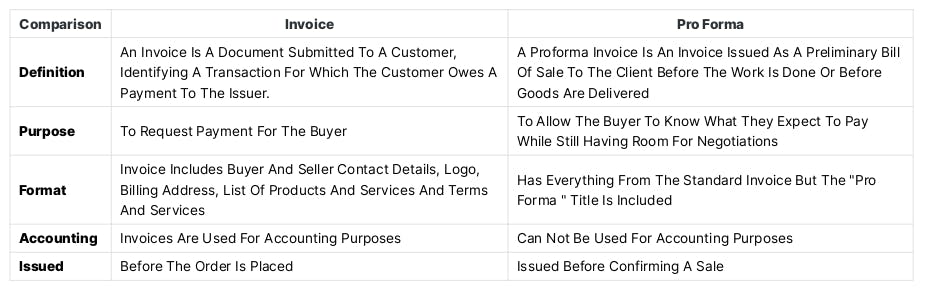
For that reason, a pro forma invoice can not be used for accounting purposes or act as a request for payment. It's mostly used for customs or as a preliminary invoice.
A Pro forma invoice is usually issued to a client when they have committed to purchase products and services. But the final details are yet to be concluded, such as quantity, delivery time, etc.
As such, If a business uses a pro forma invoice for customs, it must present a commercial invoice within a government-stipulated number of days, which varies from country to country.
While a pro forma invoice represents a preliminary notification of the terms of a purchase agreement, a formal invoice is an official commercial instrument that informs the receiving party of their payment obligations.
What Does a Pro forma Invoice Contain?
A Pro forma invoice does not have any distinct format from an invoice.
The main difference between a pro forma invoice and a commercial invoice is that the invoice number should be sequential and required for tax purposes. Whereas in the case of a pro forma invoice, invoice numbers can vary or be avoided altogether.
A pro forma invoice will contain the following details:
- Contain details
- Product and services
- Terms
- Contains "Pro forma" in the title
What are Pro forma invoices used for?
A pro forma invoice usually only needs enough information about the product and services to be delivered and allows customs to determine the value of products and services before delivery or for customs purposes.
Although a Pro forma invoice is not a legal agreement, it is a good practice as it will allow manufacturers or service providers to avoid disputes at the time of fulfillment. And will allow the client an opportunity to negotiate terms of service and delivery.
For that, pro forma invoices are used in the following cases:
- Imports and trade transactions.
- Cost estimation
- International shipping
- To process internal purchase approval processes internally for a company
- When items may be damaged in transit
- To represent a good faith estimate of the cost to avoid having the buyer pay any unexpected and significant charges once the transaction is completed
- When customers may make changes to their order
- When the project scope may increase
Differences between an invoice and a pro forma invoice
!d957c41b-6650-4104-9794-256d34d1ea9d_Screenshot+from+2022-08-08+11-51-30.png
Conclusion
A pro forma invoice is used to prevent misunderstanding about the amount due and allow for customs clearance. And if a transaction has not yet occurred, the selling firm may use a pro forma invoice.
It allows both parties to make changes to the sale, i.e, when items are damaged in transit or customers, ask for changes to their order. Or when the project scope may increase.
Related Content

What is a Sales Invoice
The invoices are one of the most important documents for any business, as they are the final record of what has been sold, how much was paid, and what is owed to the customer.
Read Article

How to Avoid Invoicing Pitfalls
Invoicing can be a complex process, but with these tips and tricks, you can streamline your billing procedures and avoid invoicing pitfalls. Keep accurate records, set clear payment terms, and automate your invoicing process to minimize errors and ensure timely payments from your clients.
Read Article

A Comprehensive Guide To types of invoice For Small Businesses
Are you struggling to get paid on time? Choosing the right type of invoice can make a big difference. Our guide offers an overview of the different types of invoices that small businesses can use to speed up payments and stay organized
Read Article
Lesley Kampinda
Published on